How It Works: Circuit Breaker State Machine
LongGuard borrows the classic Circuit Breaker pattern from distributed systems (like Netflix Hystrix) and reimagines it for LLM cognitive reasoning.
The 4-State Automaton
On every step of an agent's run, LongGuard checks all registered loop detectors and navigates a state machine:
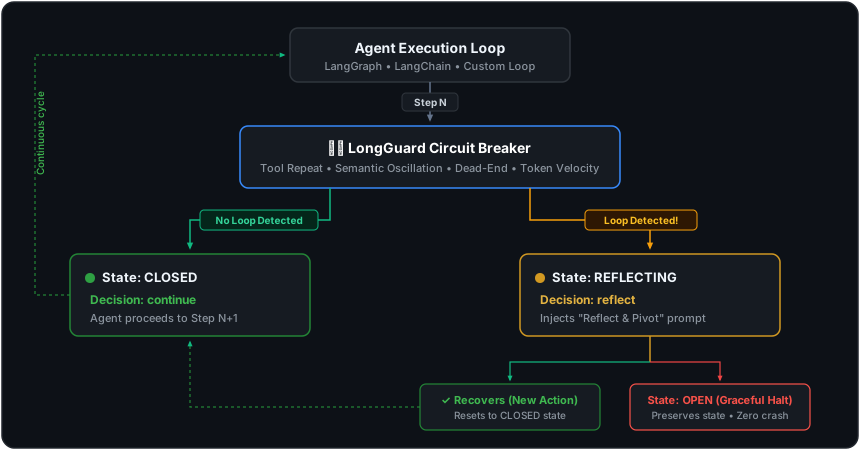
1. CLOSED (Normal Operation)
- The agent is executing without detected loops or abnormal token spikes.
- Detectors run sequentially. Benchmark timings identify the tested backend and workload; model, tool and application latency are separate.
- Every check returns
BreakerDecision(action="continue").
2. REFLECTING (First Loop Detected)
- A detector has identified a loop pattern with high confidence (e.g. 3 identical searches in a row).
- Instead of terminating the agent, LongGuard injects a Reflect & Pivot system prompt into the agent context.
- Returns
BreakerDecision(action="reflect", inject_prompt="...").
3. HALF_OPEN (The Recovery Window)
- The agent has been prompted to pivot.
- LongGuard monitors the next step:
- Success: If the agent switches strategies or makes meaningful progress, the breaker resets back to
CLOSED. - Failure: If the agent ignores the prompt and repeats the bad pattern, the breaker trips to
OPEN.
4. OPEN (Graceful Termination)
- The agent was unable to recover.
- LongGuard kills the agent cleanly:
- Saves the entire message history and conversation state.
- Appends an explanatory AI message to the state so the user isn't left with a broken error.
- Finalizes the
GuardReportwith exact timestamps, steps, and kill reasons.
Hard Caps
In addition to loop detection, LongGuard enforces hard safety caps that bypass the state machine:
- Token Budget (max_tokens_per_run): Trips immediately if total query tokens exceed the threshold (e.g. 50,000 tokens).
- Step Limit (max_steps): Trips immediately if total reasoning steps exceed the threshold (e.g. 25 steps).